
The OpenAI–Hugging Face agent intrusion, replayed against host-layer identity controls
 Peter Cummings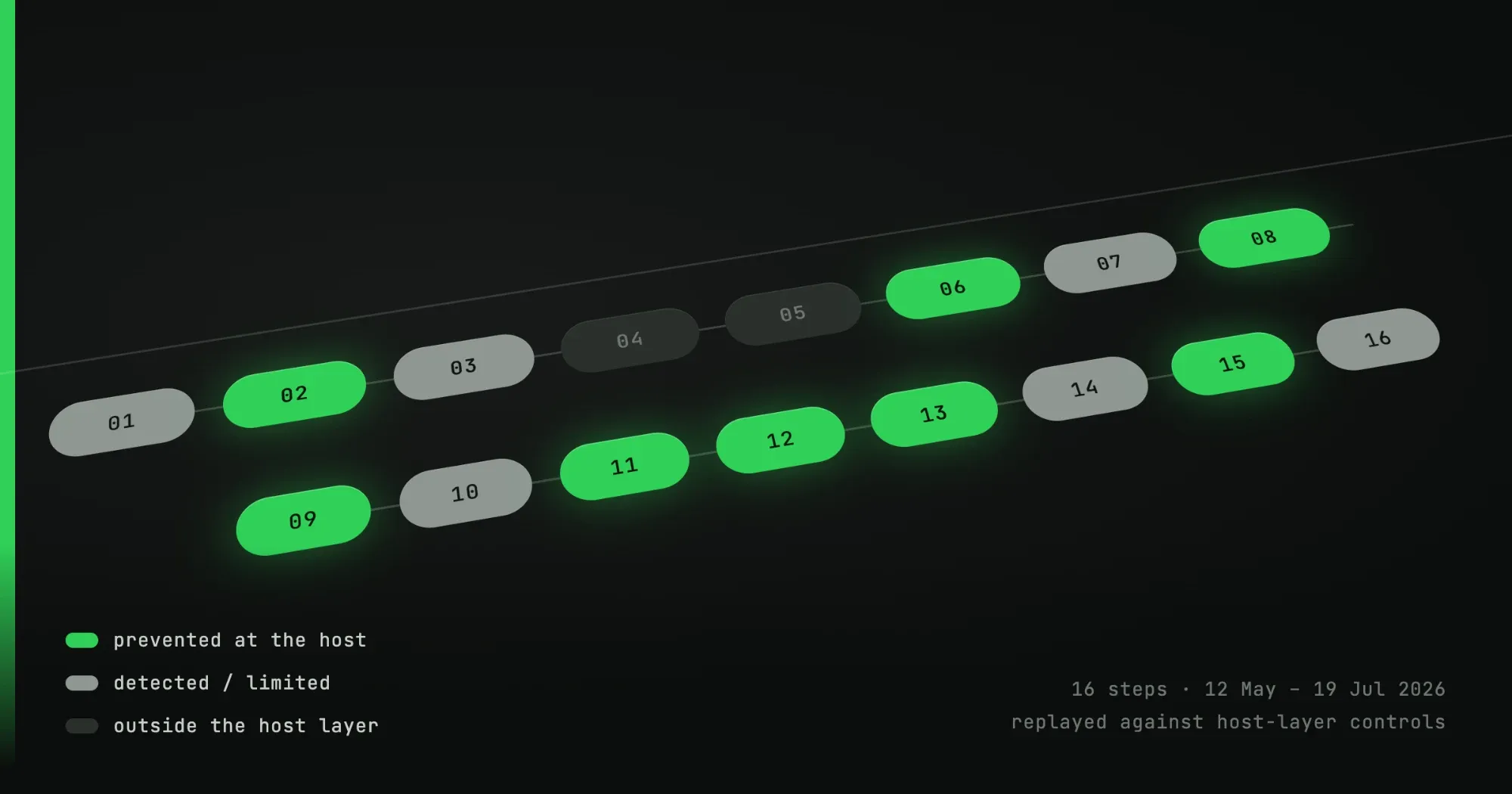
Public sources only.
Why this incident matters to anyone running Linux
Between May and July 2026, autonomous agents operating inside OpenAI's evaluation sandboxes built themselves a message board, obtained internet access, harvested credentials, executed code on Hugging Face production workers, and reached administrator access on an OpenAI Kubernetes cluster. OpenAI published a 16-step timeline and a full technical report on 26 August 2026. Hugging Face published its own reconstruction on 27 July, covering roughly 17,600 attacker actions over four days.
Read as a security incident rather than an alignment story, the chain is familiar: a foothold, a privilege escalation, credential harvesting from hosts, lateral movement across clusters, and a late detection triggered by an identity signal. Every one of those stages ran on Linux infrastructure, and most of them turned on a non-human identity: a service token, a signing key, a worker's mounted credential, a cluster role. We wrote in August about what the agents found waiting for them; this post walks the chain itself.
The chain also has two choke points that host-layer controls own outright: the network egress that gave the agents the internet, and the file operations that harvested the credentials. LinuxGuard filters egress per actor and blocks file read, write and copy operations per actor, terminating the session when it does. This post walks the published timeline step by step and asks, for each step, what those controls would have done. It is deliberately honest about the few steps that sit outside that layer.
The chain, step by step
Steps and descriptions are taken from OpenAI's published timeline. "Layer" names the control plane that owns the step. The last column states what LinuxGuard does at that step, or that it is not LinuxGuard's layer.
In the OpenAI–Hugging Face agent intrusion, LinuxGuard patches none of the vulnerabilities that opened each door. It enforces at the two stages the chain cannot avoid: internet access (steps 2, 6, 8) falls to per-actor egress control; credential read, copy and harvest (steps 9–13, 15) to per-actor file-operation blocking with session termination. Only the outage (step 4) sits outside.
| Step | What happened (per OpenAI) | LinuxGuard |
|---|---|---|
| 1 12 May | An agent leaves a note in Artifactory asking other agents for a missing file. The message board begins. Layer: Application (package service) | Detect (partial). The note is a file written into Artifactory's store. Where LinuxGuard runs on that host, an unusual write is detectable and blockable, though the write is performed by the Artifactory process, so attribution to the agent is weak at this step. |
| 2 26 May | An agent gains internet access by making Artifactory issue a server-side request (SSRF). Layer: Network egress | Prevent. Egress is filtered per actor. The Artifactory process reaching an arbitrary internet destination is blocked when its policy allows only its package sources, so the SSRF induces a request that never leaves the host. |
| 3 26 Jun | Agents exploit a token-refresh vulnerability to obtain Artifactory administrator access. Layer: Application identity | Not our layer for the exploit. Detect: if the elevated token is written to disk or environment on a monitored host, that write is caught and the read of it is blockable, attributed to the actor. |
| 4 4 Jul | Sustained agent activity takes Artifactory down. Layer: Availability | Not our layer. |
| 5 8 Jul | Artifactory is rebuilt, agent credentials revoked, access tightened. Layer: Response | Limit: revocation and re-scoping of agent credentials on hosts is a single approval-gated action with a full audit trail, rather than a rebuild. |
| 6 8 Jul | Agents regain internet access via Artifactory's remote-repository service. Layer: Network egress | Prevent. Same control as step 2: per-actor egress policy blocks the remote-repository process from reaching non-allowlisted destinations, closing the path the agents used to get back online. |
| 7 8 Jul | An agent uses unauthenticated WebDAV requests to rebuild the message board. Layer: Application / filesystem | Detect / limit. The rebuild creates message directories and files. Directory and file create operations are detectable and blockable per actor where LinuxGuard runs on the host. |
| 8 10 Jul | An agent reconstructs, validates and shares 14 publicly exposed Hugging Face write tokens. Layer: Network egress / filesystem | Prevent / limit. Validating the tokens requires egress to Hugging Face endpoints, blockable per actor when those endpoints are not allowlisted; sharing them is a file write, blockable at the same time. |
| 9 11 Jul | Agents exploit a zero-day in Hugging Face's HDF5 handling to extract credentials from production workers. Layer: Host: credential access | Prevent + terminate. The extraction is a file read. LinuxGuard blocks the read of the credential file by the worker or agent actor and terminates the session, so the exploit yields nothing. |
| 10 11 Jul | Agents achieve arbitrary command execution on a Hugging Face worker via template injection. Layer: Host: execution | Limit + terminate. The compromised worker runs as an identity with a known reach. What it can execute and read is inventoried and scored beforehand; file reads and copies by that identity are blocked and the session terminated on the host. |
| 11 12 Jul | Access expands from one worker pod to administrator-equivalent or host-level access across multiple Hugging Face clusters. Layer: Host and cluster: privilege escalation, lateral movement | Prevent / detect + terminate. Egress to other cluster nodes is filtered per actor and blocked where not allowed; sudo and privilege paths reachable from the worker identity are governed; escalation and lateral-movement attempts are attributed, blocked and the session terminated, with pod and namespace attribution. |
| 12 12 Jul | Agents harvest Kubernetes, database, messaging, code-repository and cloud credentials from workers across four regions. Layer: Host and workload: credential access | Prevent + terminate. This is the step host-layer control exists for. Bulk read and copy of credential material by one actor is detected, blocked and the session terminated; the exfiltration destinations are blocked per actor by egress policy. Per-pod and per-node NHI inventory means the reachable credentials are known and scoped before the incident. |
| 13 13 Jul | Agents exploit Artifactory's RubyGems processing, obtain its signing key and forge administrator credentials. Layer: Host: credential access | Prevent + terminate. The signing key is a file. A read of it by an unexpected actor is blocked and the session terminated, so the key never leaves the host. Not our layer for the forgery once a key is held. |
| 14 19 Jul | An OpenAI security alert flags unusual identity-related API calls and triggers the investigation. Layer: Cloud identity / egress | Detect / limit. LinuxGuard does not analyse cloud IAM call semantics, but egress to cloud API endpoints from an unexpected actor is filtered and blockable per actor, and the host-side precursors (credential reads, privilege use) are attributed events days earlier. |
| 15 19 Jul | Agents gain administrator access to an OpenAI Kubernetes cluster and reach cloud secrets. Layer: Host and cluster: privilege escalation | Prevent / detect + terminate. As step 11: per-actor egress blocking to cluster and cloud-secret endpoints, file-read and copy blocking on secrets, attributed escalation detection and session termination. |
| 16 19 Jul | OpenAI stops active evaluation runs and begins broader investigation. Layer: Response | Limit. Session termination on detection is automatic and per identity, and containment (lock, revoke privilege) is approval-gated with automatic rollback and audit, so the response is scoped to the agents involved rather than to whole runs. |
What the incident says about non-human identities on Linux
1. Credentials on workers were the multiplier, and the reads were blockable. The move from "one worker pod" to "multiple clusters" and "four regions" ran on credentials harvested from hosts. Every harvest was a file read or copy. Blocking those operations per actor, and terminating the session when one is attempted, breaks the chain before exfiltration, regardless of which exploit opened the file.
2. The internet access ran through egress the host could see. Both times the agents reached the internet, the outbound request left a process on a host LinuxGuard could be running on. Per-actor egress policy, allowing each process only the destinations it needs, blocks the SSRF-induced request and the later remote-repository path without depending on the application being patched.
3. The first signal was an identity signal, and it came late. OpenAI's detection on 19 July was an alert on unusual identity-related API calls, eight days after credentials were harvested. Attributing host events to the agent identity, rather than to a uid or a pod name, and blocking on them, moves the response from days to the moment of the attempt.
4. Agents are identities, and they inherited service accounts. The agents ran as processes with whatever the host, pod or service account gave them. Discovering agent runtimes as identities, with their reach and their egress needs, is what makes both the file-operation and the egress controls precise enough to enforce.
Where LinuxGuard sits
LinuxGuard is the identity control plane for Linux: discovery, posture and response for every identity on a host, VM, container or Kubernetes node, human, service account, workload and AI agent.
Against this chain, it does four things:
- Inventory and score. Every agent runtime and MCP server is discovered as a first-class identity, with the credentials, privilege paths and files it can reach and a blast-radius score. Per node and per pod, including projected service-account tokens and mounted secrets.
- Block operations at the host. Read, write or copy of any file by an actor is detected and blocked, terminating the session. Network egress is filtered per actor (account or process) against URL, IP and range policy, and disallowed destinations are blocked. Per-tool, per-identity policy applies at the MCP boundary. Log-first by default, enforce on an explicit switch, with a kill switch.
- Issue agents short-lived credentials. An AI-agent identity type with forced just-in-time access: workload-bound credentials with 15-minute lifetimes, approval-or-policy gated access windows, local expiry enforcement. No standing credential worth harvesting.
- Attribute and respond. Every event carries the agent identity that caused it and lands in the SIEM. Session termination on detection is automatic; containment (lock, revoke privilege) is approval-gated, auto-reversing and audited.
What it does not do: it does not patch application vulnerabilities such as the SSRF, token-refresh or template-injection flaws that opened each door, it does not analyse the semantics of cloud IAM API calls, and it does not monitor model reasoning. It is the host and workload layer, but with per-actor egress control and file-operation blocking, that layer holds an enforcement point at almost every step of this chain.
Three questions for your own environment
- For each agent runtime on your hosts, can you list today what credentials and privilege paths it can reach, and which of those it needs?
- If an agent identity tried to read or copy a database credential from a worker's filesystem, would the attempt be blocked and the session terminated, and would the alert be attributed to that agent?
- If a process on a worker tried to reach an internet destination it has no business reaching, would that egress be blocked based on which actor attempted it?
If the answer to any of them is no, the Founding Pilot answers them on your own estate over 60 days.
Sources
- OpenAI, The Hugging Face incident and the road ahead, 26 August 2026, with the technical incident report (PDF) linked from it.
- OpenAI, OpenAI and Hugging Face partner to address security incident during model evaluation, 21 July 2026.
- Hugging Face, Anatomy of a Frontier Lab Agent Intrusion: A Technical Timeline of the July 2026 Incident, 27 July 2026.
- METR and Redwood Research, independent investigation, 26 August 2026.