
Founding Pilot: a 60-day, fixed-fee pilot across your infrastructure
Get a complete, evidence-backed picture of your Linux identity posture — every path to root mapped, ready for remediation, board review or audit.
The sudo rule that got forgotten is the one attackers will find first.
A 60-day managed pilot that turns your Linux identity blind spot into a documented baseline — every account and privilege path mapped and scored, with compliance evidence and a remediation roadmap your team can act on.
Only 10 organisations will join as founding partners — each gets white-glove service and a direct hand on the roadmap, at the same fixed fee.
Free · Ungated · Anonymous
Not sure where you stand? Take the Linux Identity Maturity Assessment.
Answer 20 questions across five domains and get an instant, scored picture of your Linux identity posture — 5–8 minutes, no form to fill in.
What makes it a founding pilot
Not just a software implementation. A partnership.
We're opening the pilot to 10 organisations at the same fixed fee. Founding partners get two things that no one after them will to the same degree: a team dedicated to landing LinuxGuard in their world — integrations, auditors and all — and a direct hand on the roadmap.
White-glove service
Dedicated to landing it, not just installing it
This is bespoke service, not a report in your inbox. A senior LinuxGuard engineer is dedicated to your pilot from kickoff to handover — wiring into what you already run, working with your auditors, and planning the step from pilot to platform when you are ready for it. Available on demand and hands-on remotely; never on-site, never handed to junior staff.
- A dedicated engineer and named PM — weekly updates and a direct Slack or Teams channel to the people doing the work, available on demand.
- Integration with your IAM/IGA — findings flow into the identity stack you already run, not a parallel one you have to maintain.
- Working alongside your auditors — we help assemble the evidence and land the audit, not just hand you a report to interpret.
- From pilot to platform, on your terms — as the pilot closes, we plan the move to continuous monitoring across the full estate with you: what stays, what changes, and when.
A hand on the roadmap
Shape where we go next
Founding partners don't just use the product — they help decide what it becomes. Your environment, your priorities, and the gaps you hit go straight to the people building LinuxGuard. What you raise in a quarterly session can shape the next release, rather than sit in a backlog you never see.
- Quarterly roadmap sessions directly with the founders — a standing seat at the table where the next quarter's priorities get decided.
- Priority on feature requests that matter to your estate — moved ahead of the general backlog and built with your input.
- Tailored updates aligned to your environments and needs, so what ships next reflects the problems you actually face day to day.
- Founding pricing locked in on the product as it grows — the rate you join at holds as capability and scope keep expanding.
What We Typically Find
Across every Linux estate, these five categories account for the highest-risk findings.
Orphaned and stale accounts
Former employees, contractors, and service accounts that were never deprovisioned — still active, still capable of authenticating.
Sudo drift and NOPASSWD rules
Sudo configurations that were expanded temporarily and never locked back down. NOPASSWD entries that bypass the last authentication checkpoint on a server.
Shared and unrotated SSH keys
SSH keys shared across multiple users or systems, and authorised_keys entries that haven't been rotated in years — often pointing to accounts that no longer exist.
Service account privilege creep
Service accounts created with broad group memberships for convenience, never reviewed, and now carrying privileges far beyond what the service actually needs — the unowned service accounts no directory records.
Undocumented privilege escalation paths
Routes from a low-privilege account to root that exist through combinations of group memberships and sudo rules — none of which are individually alarming, but together create a clear escalation route.
What You Get in 60 Days
The pilot runs on a pre-defined environment agreed at kickoff — up to 500 servers, chosen to represent your estate rather than to cover all of it. It is a pilot, not a full roll-out. Everything below is delivered for that environment.
- Identity & Privilege Inventory — Every user, group, sudo rule, SSH key, and service account across the pilot environment, showing what each can do
- Risk-Scored Findings Report — Prioritised findings based on real exploit patterns, highlighting the privilege paths attackers would use first
- Compliance Evidence Package — Identity governance gaps mapped to major regulatory frameworks with remediation guidance
- Prioritised Remediation Plan — Phased plan to reduce privilege drift and move toward least-privilege, ordered by the paths to root each change closes
- Board-Ready Executive Summary — Executive summary for boards and a technical deep-dive for your security team
Founding partners get it all delivered white-glove — a dedicated senior engineer through every step, handling integration and the step from pilot to platform, plus quarterly roadmap sessions with the founders after the pilot ends.
Sample Report
A simulated post-pilot report for an EU financial services company, covering the entire estate — what continuous monitoring reports on once the pilot environment becomes the whole fleet. Yours will be built entirely around your environment — your systems, your findings, your compliance obligations.
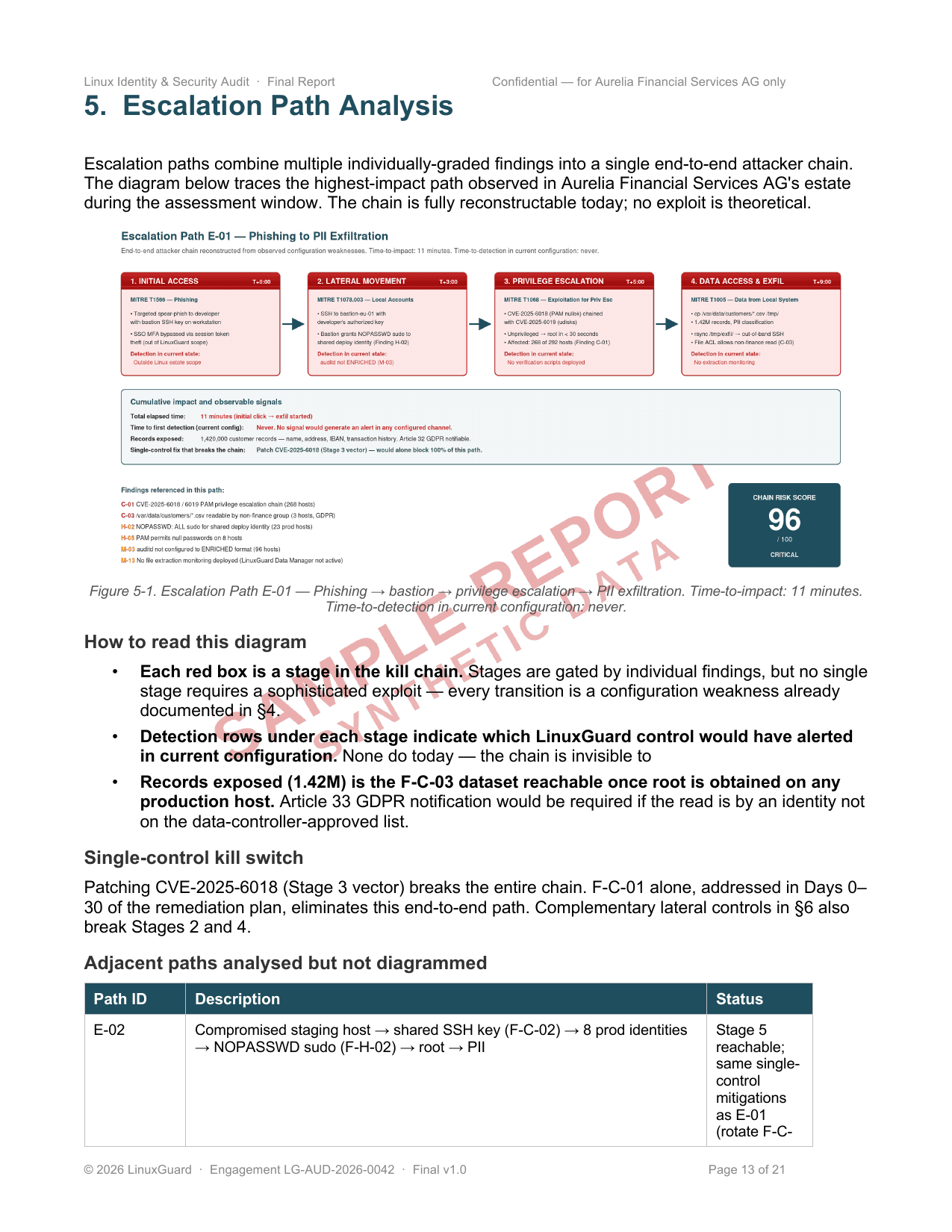
“Time-to-detection in current configuration: never.”
Figure 5-1 · Escalation Path E-01 · LinuxGuard Founding Pilot LG-AUD-2026-0042
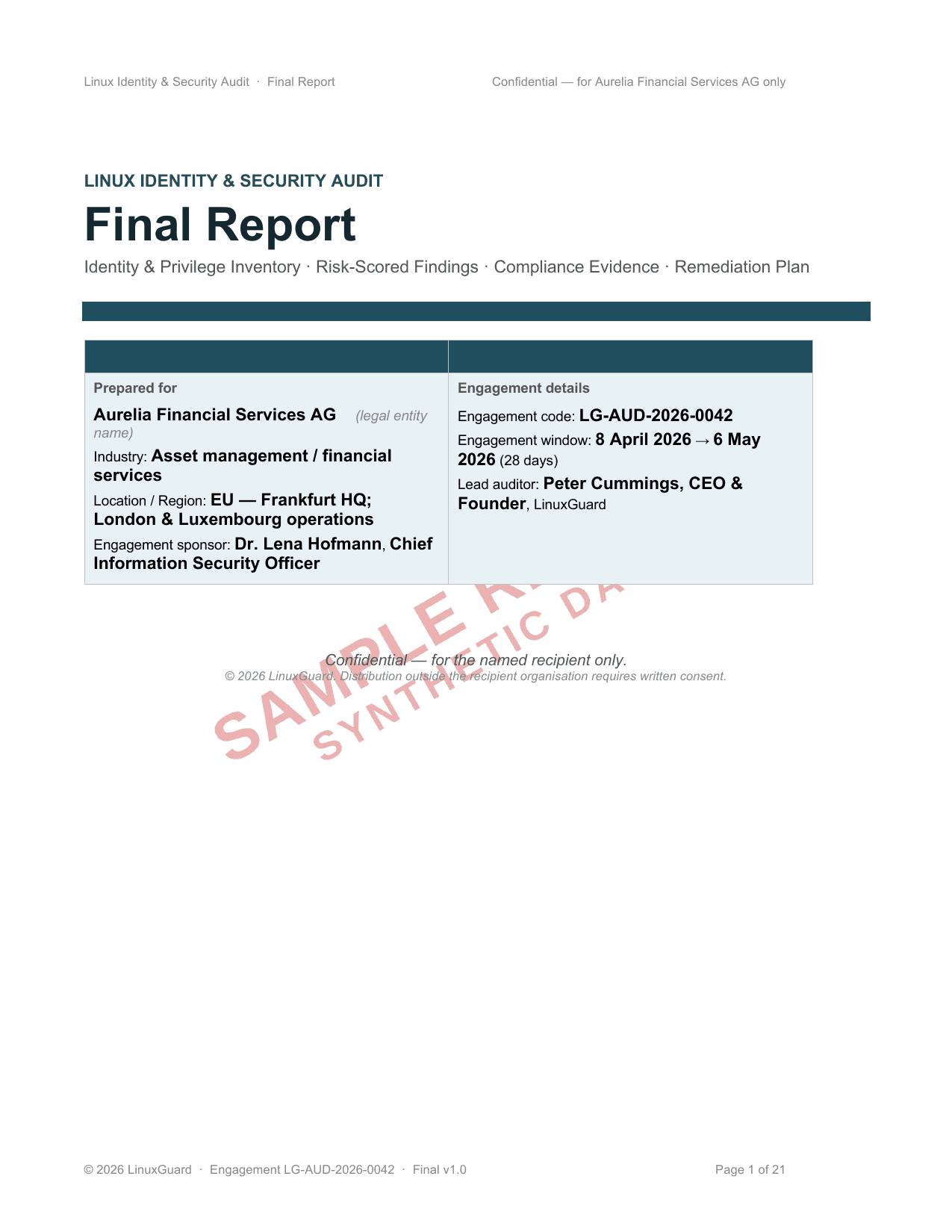
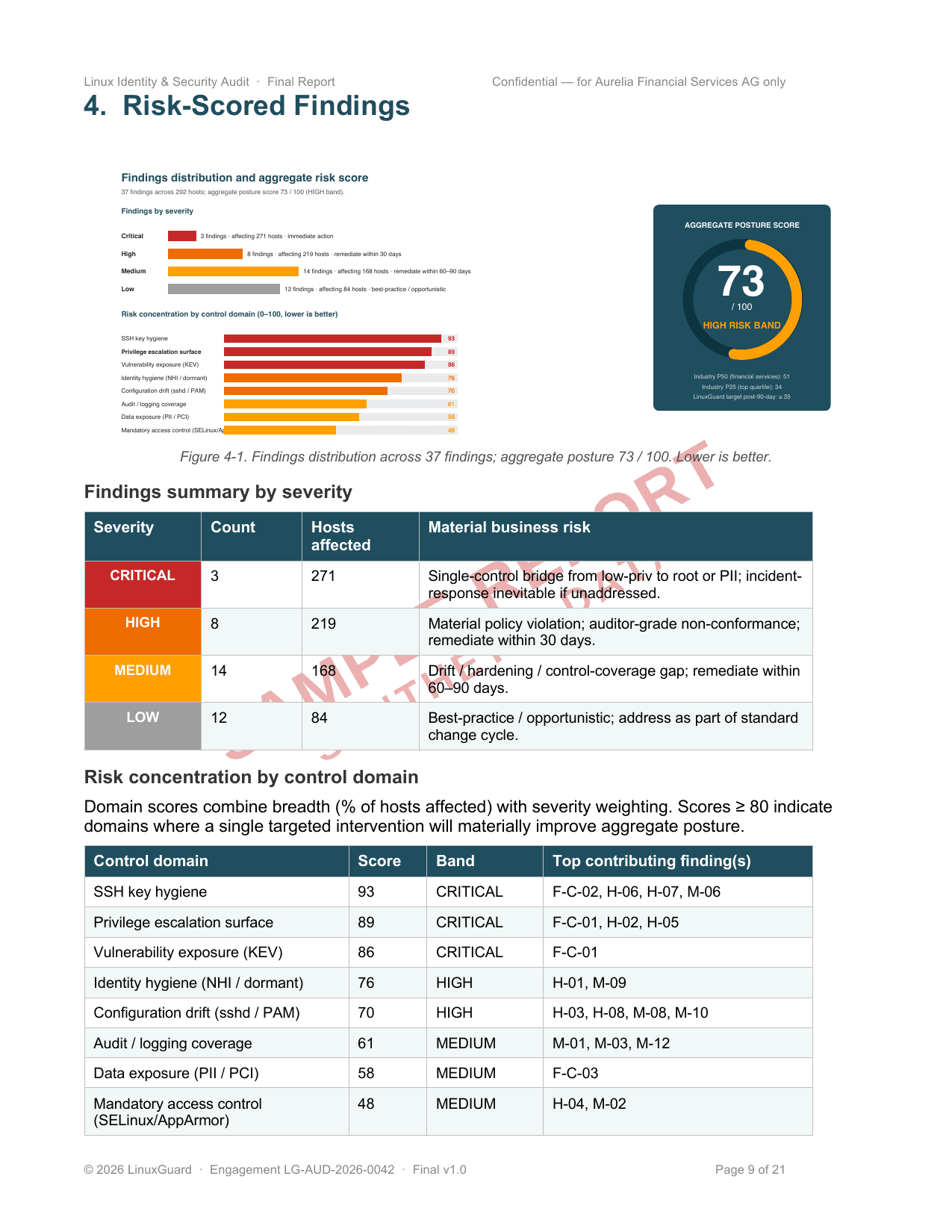
PDF · 21 pages · No form required
What Changes After the Founding Pilot
Complete visibility
Every identity and privilege path across your Linux estate, mapped.
Risk-scored findings
Prioritised results your board and audit committee can act on.
Compliance evidence
Mapped to NIS2, DORA, and SOC 2 control requirements.
Remediation plan
A prioritised 90-day plan ready for your next quarterly cycle.
Drift detection baseline
Continuous monitoring foundation established from day one.
You'll know your Linux identity posture with more precision than ever before.
Case Study
Customer Story
How a global payments firm cut Linux audit prep from weeks to a single export
An anonymised multi-country payments provider with an estate of 412 Linux servers used a LinuxGuard design partner deployment to inventory every sudo rule, SSH key, and orphaned account. The deployment uncovered 247 orphaned accounts with active sudo rules, 4 environments with shell-escape-capable sudo rules, and 31 shared SSH keys — then generated auditor-ready evidence for NIS2, DORA, and PCI DSS in a single structured package.
Compliance Framework Alignment
Our methodology aligns with industry-recognised security frameworks to ensure your identity infrastructure meets regulatory requirements.
| Framework | Alignment | Key Controls Covered | Status |
|---|---|---|---|
| NIS2 | Mapped to | Identity governance, access control, logging, incident reporting | Mandatory |
| DORA | Mapped to | ICT risk management, access control, third-party oversight | Mandatory |
| PCI DSS | Aligned with | User authentication, access restrictions, audit logging | Mandatory |
| CIS Benchmarks | Aligned with | Linux hardening, privilege management, authentication | — |
| NIST CSF | Aligned with | Identity management, access control, audit trails | — |
| SOC 2 | Aligned with | Logical access, least privilege, access reviews | — |
| ISO 27001 | Aligned with | Access control, identity management, operational security | — |
Findings and recommendations are mapped to specific framework controls for straightforward compliance documentation.
How It Works
Discovery & Scoping
Agree the pilot environment — a pre-defined set of up to 500 servers, chosen to represent your estate — identify in-scope systems, and establish secure data access. Stakeholder interviews set priorities and compliance requirements.
Identity & Privilege Mapping
Deploy lightweight, read-only collectors to gather Linux identity and privilege data across your estate. Users, groups, sudo rules, SSH keys, PAM configurations, and service accounts. Collection never changes a host; the only thing that does is a response action you have enabled and approved.
Security & Compliance Assessment
Build privilege paths, identify drift patterns, and map identity governance gaps to compliance framework controls (NIS2, DORA, CIS, NIST, SOC 2, PCI DSS). Score risks based on real exploit patterns.
Reporting & Remediation
Deliver the identity and privilege map, risk report, compliance gap analysis, and least-privilege roadmap. Two readouts: executive summary and technical deep-dive.
Dedicated Expert Support & Roadmap Access
A senior Linux identity specialist is dedicated to your pilot throughout — integrating with your IAM/IGA, working with your auditors, and planning the step from pilot to platform when you are ready. Available on demand and hands-on remotely, never on-site and never handed to junior staff. The team brings 20+ years of enterprise IAM experience across Mastercard, EY, UBS, Lonza, and UK Government agencies, with weekly updates. Founding partners keep a direct channel and quarterly roadmap sessions with the founders after delivery.
Frequently Asked Questions
Will this disrupt operations?
What if we've never mapped access before?
How does LinuxGuard handle sensitive configuration data collected during the Founding Pilot?
Does this pilot cover containerised workloads and Kubernetes environments?
What happens after the pilot ends?
Book a demo and claim a founding spot
See who can do what on every Linux server you run — delivered white-glove, with a direct hand on where LinuxGuard goes next.
Prefer email? contact@linuxguard.io