
LinuxGuard Blog
Insights on Linux security, identity visibility, least privilege, and DevSecOps best practices.
•8 min read
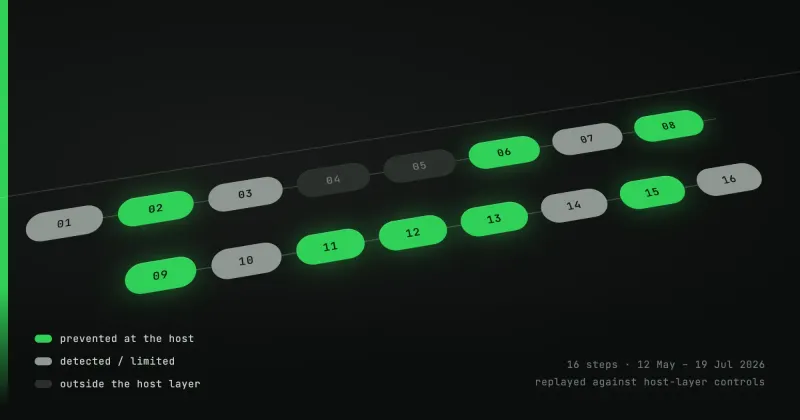
The OpenAI–Hugging Face agent intrusion, replayed against host-layer identity controls
Public sources only.
Why this incident matters to anyone running Linux
Between May and July 2026, autonomous agents operating inside OpenAI's evaluation sandboxes built themselves a message board, obtained internet access, harvested credentials, executed code on Hugging Face production workers, and reached administrator access on an OpenAI Kubernetes cluster. OpenAI published a 16-step timeline and a full technical report on 26 August 2026. Hugging Face published its own reconstruction on 27
Linux Identity SecurityCredential-based breachesNews

•7 min read
CMMC Audit Logging on Linux
What Does CMMC Require of Linux Audit Logs?
CMMC Level 2 requires Linux systems that store or process controlled unclassified information to create, retain and protect audit logs. The requirement comes from NIST SP 800-171 practice AU.L2-3.3.1, which CMMC adopts. On Linux that means an auditd ruleset covering logons, identity and credential file changes and privileged commands, with logs shipped off the host.
CMMC — the Cybersecurity Maturity Model Certification — is the US Department of Defen
Compliance

•7 min read
PCI DSS Requirements 7 and 10 on Linux
What Do PCI DSS Requirements 7 and 10 Require on Linux?
PCI DSS 4.0.1 applies Requirements 7 and 10 to every Linux host in the cardholder data environment. Requirement 7 restricts access to the minimum each role needs, which on Linux means accounts, groups and sudo rules. Requirement 10 requires every use of that access to be logged, which on Linux means auditd.
PCI DSS — currently version 4.0.1 — governs any system in the cardholder data environment (CDE): the systems that store, process, or
Compliance

•8 min read
Linux Access Control under the UK NCSC Cyber Assessment Framework
Does the NCSC CAF Apply to Linux?
The NCSC Cyber Assessment Framework applies to Linux indirectly. It names no operating system, but Principle B2, Identity and Access Control, requires organisations to understand, document and manage access to the systems supporting essential functions. On a Linux estate that means the accounts, sudo rules, SSH keys and service accounts on every in-scope host.
The NCSC Cyber Assessment Framework — the CAF — is the UK's outcome-based framework for judging wheth
Compliance

•7 min read
Linux Access Control Evidence for SOX ITGC
What Does SOX Require of Linux Systems?
The Sarbanes-Oxley Act does not name Linux, but Section 404 brings Linux servers into scope wherever they run financial-reporting systems. Auditors assess IT general controls on those hosts under PCAOB standard AS 2201: who has an account, who can use sudo, how changes are approved, and whether access is reviewed.
The Sarbanes-Oxley Act never mentions Linux, yet SOX shapes how every Linux server under a financial-reporting system must be controlled. Sect
Compliance

•7 min read
Non-Human Identity on Linux
What Is a Non-Human Identity on Linux?
A non-human identity on Linux is any account, key, or credential that authenticates to a system without a person behind it — a service account that runs a daemon, an SSH key that lets one host reach another, an API token a script uses to call a controller. It is the machine equivalent of a user, and on a modern Linux estate there are far more of them than there are people.
The scale is easy to underestimate. Palo Alto Networks' 2026 Identity Security Land
Linux Identity SecurityCompliance

•5 min read
How LinuxGuard Protects Against Agentic Attacks
When OpenAI published its account of the Hugging Face incident, what stood out was not what the agents did. It was what they found waiting for them: exposed credentials, over-permissioned service accounts, workers that could be turned into an administrator's foothold. None of it was created by an agent. It was the ordinary residue of running infrastructure at scale — the same residue most Linux estates carry today.
What was new was the actor. A collective of autonomous agents, coordinating thro
Credential-based breachesConfiguration drift detectionLinux Identity Security

•21 min read
Linux Privileged Access Management in 2026: 9 Tools Compared
Linux privileged access management tools fall into five groups: credential vaults and session brokers (CyberArk, Delinea), privilege elevation (BeyondTrust), identity management (FreeIPA), access proxies and secrets brokers (Teleport, StrongDM, HashiCorp, Okta Privileged Access), and privilege visibility and posture (LinuxGuard). They solve different problems, and most estates need more than one.
Jump to the comparison at a glance.
The Wrong Question Is Costing You
When a security team goes
Linux Identity SecurityZero Trust for LinuxConfiguration drift detection

•10 min read
SSH Key Management on Linux: The Privilege You're Not Governing
What Is SSH Key Sprawl?
SSH key sprawl is the uncontrolled accumulation of SSH keys across a Linux estate: authorised keys added ad hoc, never rotated, and rarely inventoried. Over time, orphaned keys — belonging to departed staff, decommissioned services, or forgotten automation — pile up as unmanaged credentials that quietly grant standing access no one is tracking.
SSH keys are now one of the largest ungoverned identity surfaces in most Linux estates — and by far the least visible. In 2026,
Linux Identity SecurityZero Trust for LinuxCredential-based breaches

•8 min read
How a Forgotten Linux Account Can Put Your CEO Personally at Risk Under NIS2
The auditor doesn't care that you're busy. The regulation doesn't care that Linux is hard. And the attacker who finds that sudo rule you forgot about in 2019 definitely doesn't care.
NIS2DORAEU AI ACT

•17 min read
Linux Access Controls Under NIS2, DORA, and the EU AI Act: The Complete Evidence Guide for IT Teams
The audit email lands on a Tuesday morning. Your auditor wants evidence of privileged access controls across your Linux estate — who had root, when, what changed, and how you know. You open your SIEM dashboard. You check your IGA platform. Neither has what you need. This is the Linux compliance gap, and it is costing security teams across finance, utilities, and manufacturing weeks of frantic manual work every audit cycle.
This guide exists because three major EU regulatory regimes now converg
ComplianceDORAEU AI ACT

•4 min read
Everywhere. Every Architecture. Every Workload.
The last months have been about building something we've needed for a long time: a security platform that actually follows your infrastructure, instead of forcing your infrastructure to conform to the platform.
I want to walk you through what we shipped and why it matters—not in the abstract, but in the concrete terms of what you can now do that you couldn't do before.
Container-Native Monitoring
Every container now tells its story. When an event fires—a privilege escalation, an authenticati
Linux Identity SecurityZero Trust for LinuxConfiguration drift detection

•5 min read
The Emperor's New Controls: Why Your Lawyers Should Be Asking the Questions that Your CISO Isn't
There is an open question for legal teams. They probably just don't know it yet.
The wrong room has been running this conversation
For the last decade, the debate about identity security, Zero Trust, and access governance has lived entirely inside IT. CISOs present to boards. CSOs brief the CFO. Security vendors sell to procurement committees. The language is technical — MFA, ZTNA, PAM, IGA, NHI — and the outcomes are measured in frameworks certified, audits passed, and controls deployed.
Me
Linux Identity SecurityCredential-based breachesConfiguration drift detection

•10 min read
Copy Fail: The Exploit That Leaves No Trace on Disk
Updated September 2026: corrected the vulnerability timeline and KEV date, the detection, discovery and regulatory wording, and added related kernel flaws disclosed since original publication.
What Is CVE-2026-31431 (Copy Fail)?
CVE-2026-31431, publicly known as Copy Fail, is a local privilege escalation flaw in the Linux kernel's algif_aead crypto module, affecting kernels built from 2017 up to the patch. It lets a local attacker write controlled bytes into the page cache of setuid binaries.
Linux Identity SecurityNews

•8 min read
Why I built LinuxGuard
Early in my career, I broke a client’s production system in the worst possible way.
It was a last‑minute fix before a big presentation. I had access to the Linux server, I was under pressure, and I made a single recursive permissions change from root. It felt harmless in the moment — a quick way to “just make it work” before the meeting. Twenty minutes later, sitting in the middle of the client presentation, I watched their website die in slow motion as cache TTLs expired and processes started
Linux Identity SecurityZero Trust for LinuxConfiguration drift detection

•6 min read
Linux: The System IAM Forgot
When I started out in IT, Identity & Access Management wasn't really a discipline — it was just common sense. You controlled who could get in, you made sure they could only do what they needed to do, and you documented it well enough that you could explain it to someone if things went wrong. It was practical, technical, and grounded in how systems actually worked.
Over time, a whole industry grew up around that common sense. IAM became its own domain, with frameworks, tools, vendors, certificat
Linux Identity Security

•4 min read
What CrackArmor Teaches Us About Linux Security Assumptions
Nine critical AppArmor flaws have exposed 12M+ Linux systems since 2017. Learn why default security assumptions fail and how to verify your Linux privilege landscape.
News

•7 min read
Why Your PAM Solution Isn't Protecting Your Linux Estate (And What to Do About It)
Here is a question that should be simple: "Who can do what on our Linux servers right now?"
Not who should have access. Not who had access last quarter. Right now.
Linux Identity SecurityConfiguration drift detectionCredential-based breaches

•14 min read
Stop Cosplaying Cybersecurity and Start Fixing the Real Problems
If I see one more security leader proudly present a 200-slide deck from a very reputable firm with an impressive logo that cost more than their entire security team's annual salaries, I might actually lose it.
You know the presentation I'm talking about. The one with the maturity models. The capability heat maps. The three-year roadmap with swimlanes that look like they were designed by someone who's never actually logged into a Linux server. The one that makes the board nod approvingly while
Linux Identity Security

•9 min read
January 2026: When 'I Just Logged In' Became the Most Expensive Four Words in Cybersecurity
January 2026: 29 breached organizations, 5.5M exposed records—all preventable. Learn how Linux identity visibility stops credential attacks, insider threats & zero-days.
Linux Identity SecurityCredential-based breachesZero Trust for Linux

•3 min read
The Three Laws of Linux Privilege Security
In enterprise security, the conversation around privileged access often ends too early. We talk about vaulting passwords, rotating secrets, enforcing MFA — and then declare victory.
sudoZero Trust for LinuxLinux Identity Security

•4 min read
Continuous Privilege Monitoring Across a Linux Estate
For years, enterprises have poured millions into identity platforms, SIEM systems, and compliance tools — all with the same goal: visibility.
And yet, when it comes to Linux, most organizations still can’t answer one of the simplest and most critical questions in security
Linux Identity SecurityZero Trust for Linux

•3 min read
Linux Privilege Escalation: How One Sudo Rule Leads to Root
Every security breach starts with a single decision that seemed harmless at the time.
sudoLinux Identity SecurityConfiguration drift detection
•6 min read
Sudo Drift and Privilege Sprawl on Linux
In many Linux environments, sudo access often ends up treated like a permanent hall pass: once someone gets it, they usually keep it. There’s rarely an automatic expiry, consistent auditing, or a central inventory showing who has elevated privileges and what they can do across the estate.
sudoConfiguration drift detectionLinux Identity Security

•3 min read
IVIP: Beyond the Buzzword, Toward Identity Reality
Every few years, the identity industry gets a new acronym. Some fade quickly. Others reshape the way we think. The newest entry is IVIP — Identity Visibility & Intelligence Platforms.
Since Gartner added IVIP to their Hype Cycle, the debate has been lively. Analysts like Martin Kuppinger and Matthias Reinwarth have rightly asked:
* Is IVIP truly new, or just a repackaging of existing ideas?
* Is it a platform in its own right, or simply a capability?
* Does it overlap with ITDR (Identity
Zero Trust for LinuxLinux Identity SecurityCompliance