

Linux Identity & Security Audit
The sudo rule you forgot about is the one attackers will find first.
$4.67M
Avg cost of a credential-based breach
IBM Cost of Data Breach 2025
€10M / 2%
Max fine under NIS2 (whichever is higher of revenue)
NIS2 Art. 34
$250K+
CISO avg salary — one year of unaddressed risk
Glassdoor
22%
of breaches begin with stolen or misused credentials
Verizon DBIR 2025
$17.4M
avg annual cost of insider risk per organization
Ponemon/DTEX 2025
Credential-based breaches take 246 days to detect (IBM Cost of Data Breach 2025). Our audit maps every identity, privilege, and access path across your Linux estate in 28 days — with continuous monitoring detecting changes within a 30-second collection window.
Most security teams know who logs into their Linux servers. Almost none know what those users can actually do. That gap — between authentication and actual privilege — is where attackers live.
Linux is your most dangerous blind spot precisely because everyone deprioritizes it. Identity-first security for Linux closes that gap — continuous identity visibility, least-privilege enforcement, and continuous drift detection. Guardrails, not gatekeepers.

Peter Cummings
CEO & Founder | 20+ years IAM at Mastercard, EY, Lonza, UBS
The Audit Gap Your Current Tools Cannot Close
Security teams prepare for audits by gathering screenshots and spreadsheets. Linux identity data lives in configuration files scattered across hundreds of servers -- no existing tool collects, correlates, and maps it into audit-ready evidence.
- Configuration management databases track assets, not identity relationships between users and privileges
- Endpoint agents monitor threats but do not inventory who can sudo to root on which servers
- Manual audit processes take weeks because privilege data must be gathered server by server
- The LinuxGuard audit maps your entire Linux identity estate in 28 days with structured, auditor-ready output
The Identity Visibility Gap
- What is our actual exposure from Linux identity and privilege misconfiguration?
- Which privilege paths would an attacker exploit first?
- Are we compliance-ready for identity governance on Linux?
- What should we prioritize next quarter to close the biggest gaps?
- If an incident happened right now, how long would it take your team to produce a complete privilege map of who had access to what?
Not sure about your exposure? → Start with a 30-minute scoping call.
What We Typically Find
Across every Linux estate we audit, these five categories account for the highest-risk findings.
Orphaned and stale accounts
Former employees, contractors, and service accounts that were never deprovisioned — still active, still capable of authenticating.
Sudo drift and NOPASSWD rules
Sudo configurations that were expanded temporarily and never locked back down. NOPASSWD entries that bypass the last authentication checkpoint on a server.
Shared and unrotated SSH keys
SSH keys shared across multiple users or systems, and authorised_keys entries that haven't been rotated in years — often pointing to accounts that no longer exist.
Service account privilege creep
Service accounts created with broad group memberships for convenience, never reviewed, and now carrying privileges far beyond what the service actually needs.
Undocumented privilege escalation paths
Multi-hop paths from a low-privilege account to root that exist through combinations of group memberships, sudo rules, and setuid binaries — none of which are individually alarming, but together create a clear escalation route.
What You Get in 28 Days
- Identity & Privilege Inventory — Every user, group, sudo rule, SSH key, and service account across your Linux estate, showing who can do what
- Risk-Scored Findings Report — Prioritized findings based on real exploit patterns, highlighting the privilege paths attackers would use first
- Compliance Evidence Package — Identity governance gaps mapped to Major regulatory frameworks with remediation guidance
- Prioritized Remediation Plan — Phased plan to reduce privilege drift and move toward least-privilege, with a zero trust alignment overlay where applicable
- Board-Ready Executive Summary — Executive summary for boards and a technical deep-dive for your security team
Format: Fixed scope, fixed fee, fully remote. Completed within 4 weeks. Weekly progress updates via video conference. All deliverables in digital format.
Sample Report
A simulated engagement report for an EU financial services company.
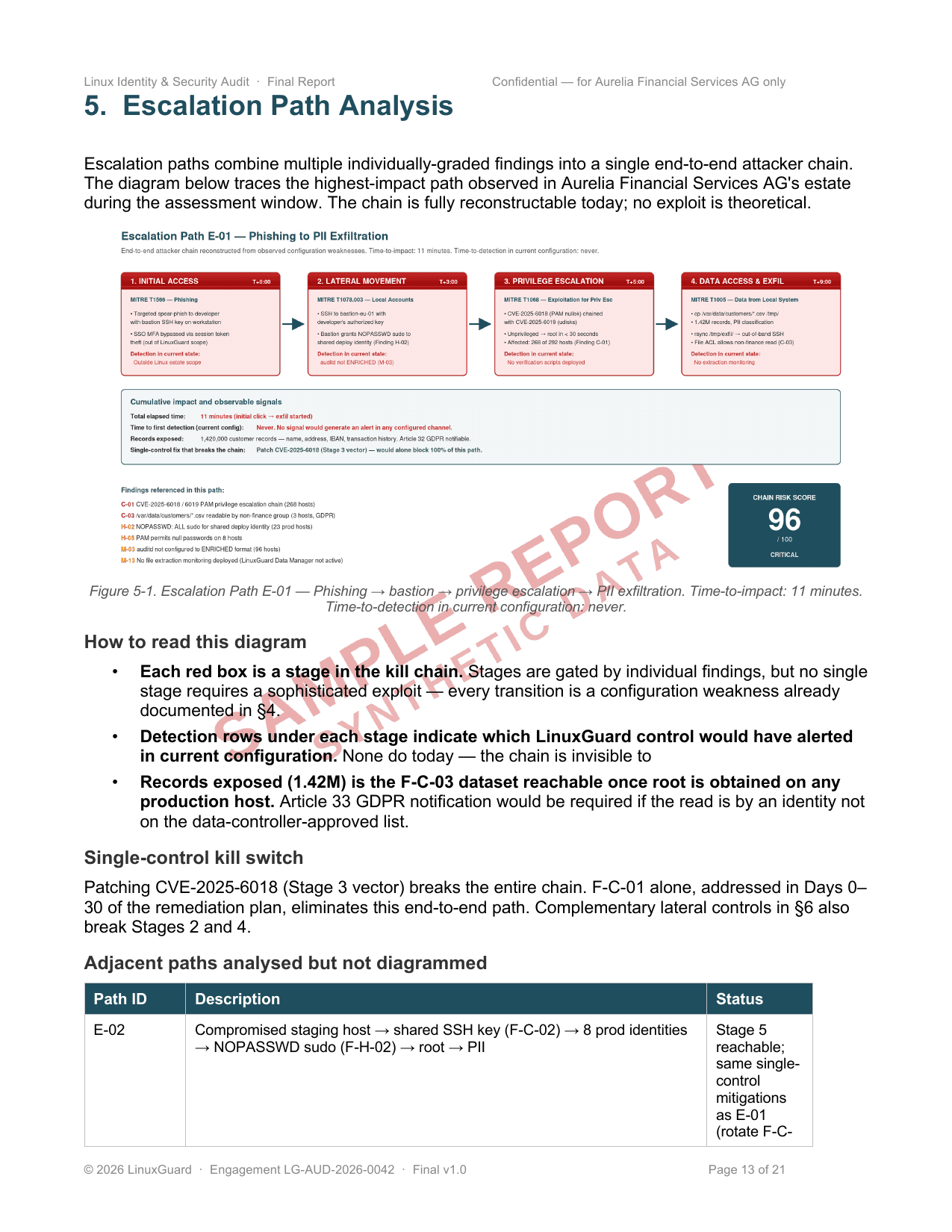
“Time-to-detection in current configuration: never.”
Figure 5-1 · Escalation Path E-01 · LinuxGuard Audit LG-AUD-2026-0042
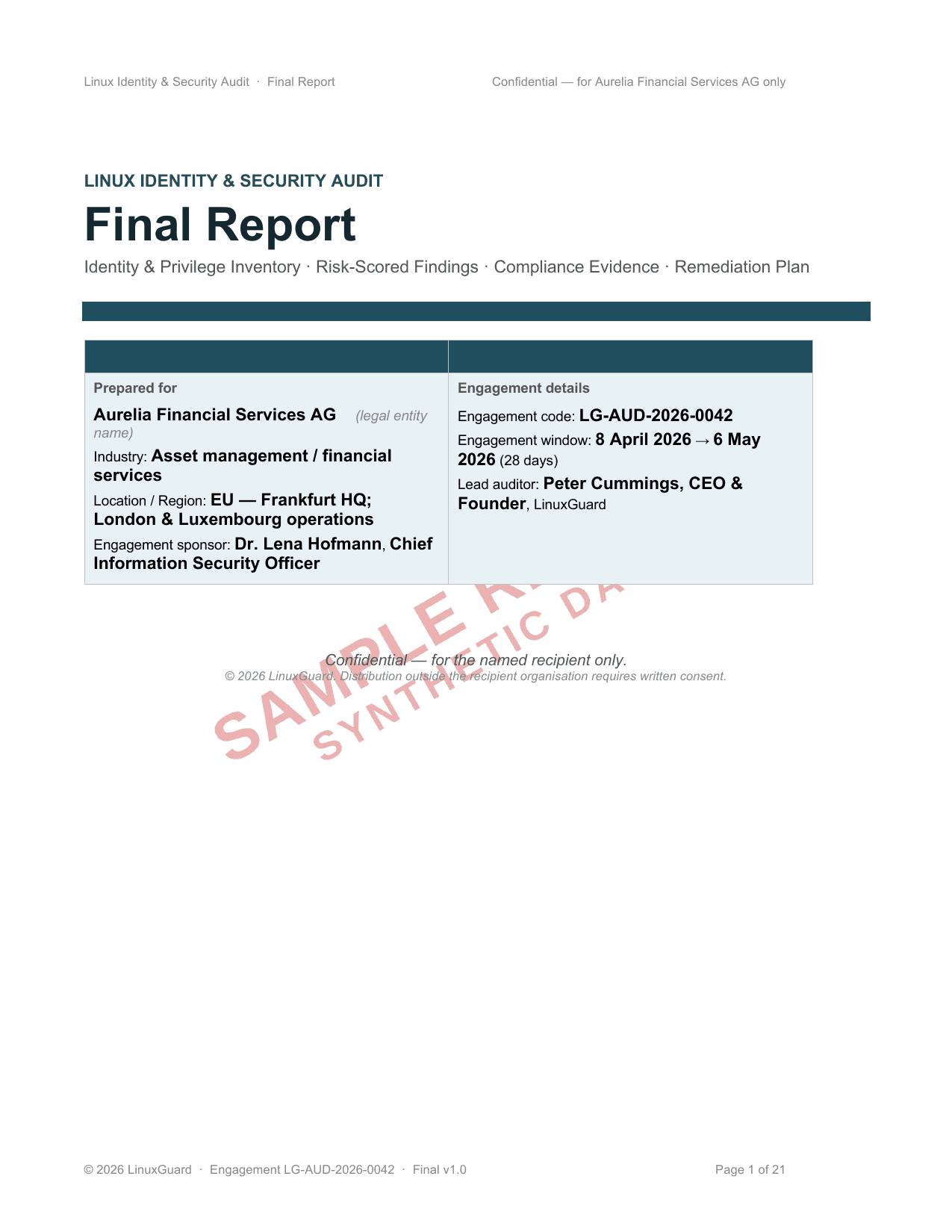
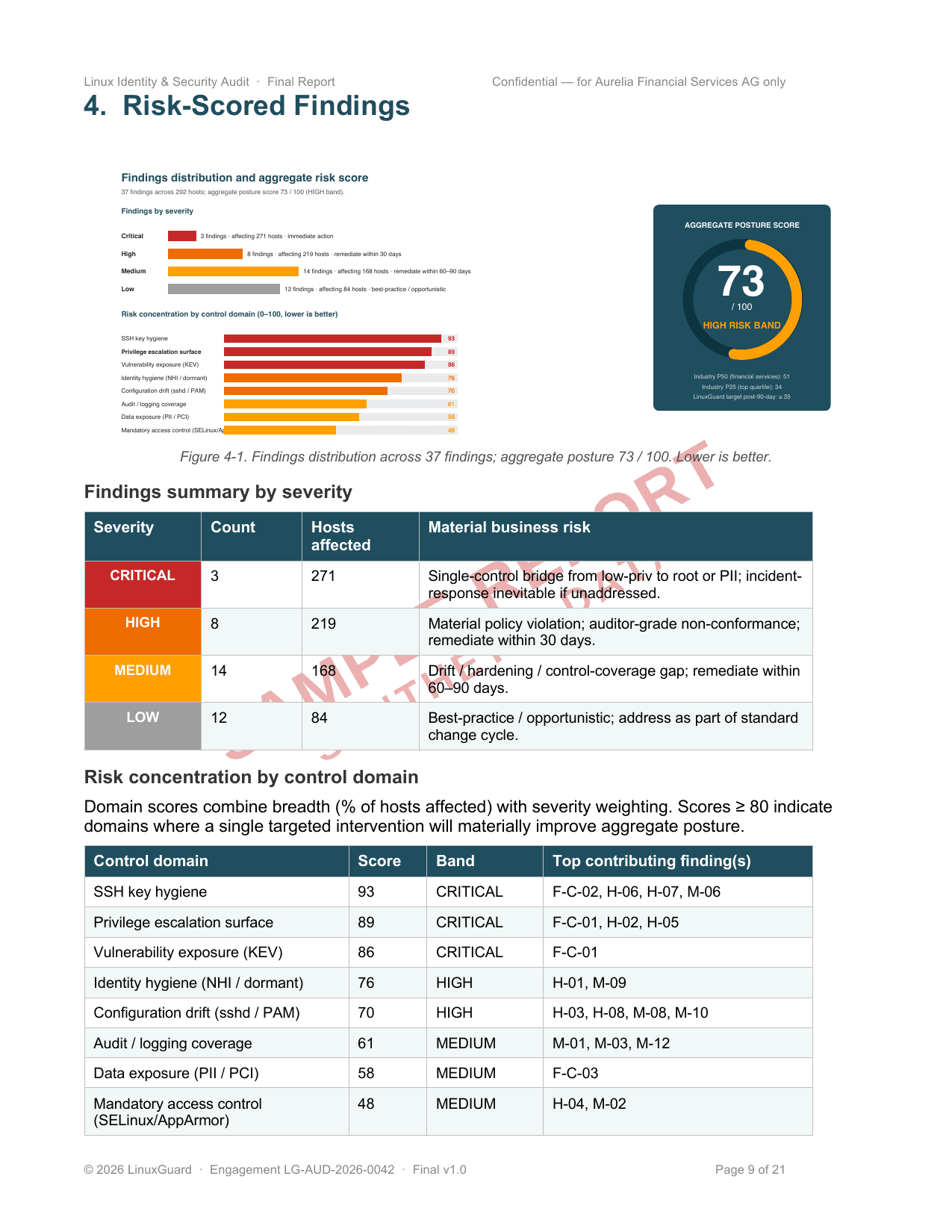
PDF · 21 pages · No form required
What Changes After the Audit
Complete visibility
Every identity and privilege path across your Linux estate, mapped.
Risk-scored findings
Prioritised results your board and audit committee can act on.
Compliance evidence
Mapped to NIS2, DORA, and SOC 2 control requirements.
Remediation plan
A prioritised 90-day plan ready for your next quarterly cycle.
Drift detection baseline
Continuous monitoring foundation established from day one.
You walk away knowing your Linux identity posture with more precision than any previous assessment.
Case Study
Customer Story
How a global payments firm cut Linux audit prep from weeks to a single export
A multi-country payments provider with hundreds of Linux systems used the Linux Identity & Security Audit to inventory every sudo rule, SSH key, and orphaned account. The audit uncovered 247 orphaned accounts with active sudo rules, 4 environments with GTFOBins-exploitable privilege escalation paths, and 31 shared SSH keys — then generated auditor-ready evidence for NIS2, DORA, and PCI DSS in a single structured package.
Read the full case study →Compliance Framework Alignment
Our methodology aligns with industry-recognized security frameworks to ensure your identity infrastructure meets regulatory requirements.
| Framework | Alignment | Key Controls Covered | Status |
|---|---|---|---|
| NIS2 | Mapped to | Identity governance, access control, logging, incident reporting | Mandatory |
| DORA | Mapped to | ICT risk management, access control, third-party oversight | Mandatory |
| PCI DSS | Aligned with | User authentication, access restrictions, audit logging | Mandatory |
| CIS Benchmarks | Aligned with | Linux hardening, privilege management, authentication | — |
| NIST CSF | Aligned with | Identity management, access control, audit trails | — |
| SOC 2 | Aligned with | Logical access, least privilege, access reviews | — |
| ISO 27001 | Aligned with | Access control, identity management, operational security | — |
| GDPR | Aligned with | Access governance, data protection, accountability | — |
| SOX | Aligned with | Access controls, segregation of duties, audit trails | — |
| HIPAA | Aligned with | Access controls, audit logging, unique user identification | — |
Audit findings and recommendations are mapped to specific framework controls for straightforward compliance documentation.
How It Works
Discovery & Scoping
Week 1Align scope, identify in-scope systems, and establish secure data access. Stakeholder interviews set priorities and compliance requirements.
Identity & Privilege Mapping (Weeks 1-2)
Deploy lightweight, read-only collectors to gather Linux identity and privilege data across your estate. Users, groups, sudo rules, SSH keys, PAM configurations, and service accounts.
Security & Compliance Assessment (Weeks 2-3)
Build privilege paths, identify drift patterns, and map identity governance gaps to compliance framework controls (NIS2, DORA, CIS, NIST, SOC 2, PCI DSS). Score risks based on real exploit patterns.
Reporting & Remediation
Week 4Deliver the identity and privilege map, risk report, compliance gap analysis, and least-privilege roadmap. Two readouts: executive summary and technical deep-dive.
Zero project management overhead.
We handle everything — your total commitment across all four phases is ~5 hours of your time total.
How We Work
Fixed scope, fixed fee, fully remote. Completed in 4 weeks with weekly progress updates.
All deliverables in digital format.
Designed to deliver concrete outcomes and board-ready evidence.
The audit is designed to deliver concrete outcomes and board-ready evidence while setting the foundation for ongoing platform adoption.
Why PAM and Vulnerability Scanners Miss This
PAM solutions (CyberArk, BeyondTrust, HashiCorp Vault) manage privileged credential vaulting and session recording — they protect against misuse of known privileged accounts.
Vulnerability scanners (Nessus, Qualys) find unpatched CVEs and misconfigurations against known signatures.
The Linux Identity & Security Audit does something different: it maps the complete privilege topology of your estate — who can escalate to root via sudo, which service accounts have overprivileged group memberships, where SSH keys are shared across systems — and shows you the paths attackers would exploit first, regardless of whether a CVE is involved. Most privilege escalation in production environments exploits legitimate, misconfigured, or forgotten access rather than unpatched software. We find the governance gaps that PAM and scanners miss.
Why LinuxGuard?
Generalist security tools weren't built for Linux identity. Here's what that gap looks like in practice.
| What's Needed | Manual/Internal Effort | Vulnerability Scanner | PAM Platform | LinuxGuard Audit |
|---|---|---|---|---|
| Complete inventory of all Linux users, groups, service accounts | Possible but slow; server-by-server | Not designed for this | Managed accounts only; not full estate | Full fleet inventory in 28 days |
| Sudo rule analysis and NOPASSWD risk identification | Requires scripting skill; inconsistent | Out of scope | Not a PAM function | Complete sudoers parsing and risk scoring |
| SSH key audit (shared, unrotated, orphaned) | Manual; easy to miss cross-server relationships | Out of scope | Managed vaulted keys only | Cross-fleet SSH key mapping |
| Privilege escalation path detection (GTFOBins, setuid) | Requires red-team skill | CVEs only; no path analysis | Out of scope | Multi-hop escalation path analysis |
| Compliance evidence mapped to NIS2/DORA/CIS/SOC 2 | Requires framework mapping expertise | Raw scan output; not mapped | Session logs; not identity posture | Structured, auditor-ready, control-mapped |
| Board/auditor-ready report | Spreadsheet + screenshots | Technical scan output | Session management reports | Executive and technical report included |
| Continuous monitoring (post-audit drift detection) | Requires ongoing internal resource | Scheduled scans only | Session monitoring only | 1.2-second change detection |
| Fixed scope and fixed cost | Variable; depends on estate size and skill | Tool cost + internal time | High licensing + professional services | €24,000 Q2 / €36,000 standard |
| Time to actionable results | Weeks to months | Fast scan, slow remediation | Months to deploy and baseline | 28 days |
Frequently Asked Questions
Why does this cost €24K?
The €24,000 Q2 rate (€36,000 standard) covers a 28-day fixed-scope engagement delivered by Linux-native identity specialists — not generalist consultants billing hourly. You get a complete privilege map across every server, sudo rule, SSH key, PAM module, and service account; an audit-ready evidence pack mapped to SOC 2, NIS2, DORA, and CIS; and a continuous drift detection baseline. Manual reviews of an estate this size typically consume 200–400 internal hours and still miss orphaned accounts and privilege creep — at a fully-loaded cost well above the audit fee. Identity-first security for Linux pays for itself the first time it surfaces a NOPASSWD rule that should never have shipped.
What's included in the €24K?
Everything: 28 days of expert engagement, the full identity inventory across users, groups, sudo rules, SSH keys, PAM stacks, and service accounts; a privilege drift report identifying orphaned accounts and least-privilege violations; a compliance evidence pack mapped to SOC 2 CC6, NIS2 Art. 21, DORA, and CIS Linux benchmarks; remediation prioritisation; and a final readout with your team. There are no per-server fees, no add-on modules, and no project-management overhead — your total time commitment across all four phases is ~5 hours. We handle everything else.
Will this disrupt operations?
No. The audit is read-only — we collect identity artefacts (sudoers files, SSH keys, PAM stacks, group memberships, service-account inventories) using lightweight, signed collection scripts that you review and run. There are no agents to deploy, no kernel modules, no changes to authentication flows during discovery. Production traffic, application performance, and authentication latency are unaffected. Continuous drift detection runs out-of-band against the same artefacts. Your total time commitment across all four phases is ~5 hours — guardrails, not gatekeepers. We handle the rest.
What if we've never had an audit?
That's the most common starting point — and the highest-value one. First-time engagements typically surface the largest pool of orphaned accounts, NOPASSWD sudo rules, shared SSH keys, and privilege creep, because nothing has ever been mapped before. We bring a Linux-native methodology, a fixed-scope 28-day plan, and an evidence pack mapped to SOC 2 CC6, NIS2 Art. 21, DORA, and CIS Linux benchmarks. You get identity visibility and least-privilege baselines from day one — no prior audit history required, no spreadsheets to retrofit. Identity-first security for Linux starts with what you already run.
How does LinuxGuard handle sensitive configuration data collected during the audit?
All data collected during the audit — sudo rules, group memberships, SSH key fingerprints, PAM configurations — is encrypted using TLS 1.3 in transit and AES-256 at rest. Data is processed in isolated, access-controlled environments with strict need-to-know access. We do not retain raw configuration data beyond 90 days post-engagement, and we can execute a formal data destruction certificate on request. Our process is aligned with GDPR Article 5 data minimisation and purpose limitation principles. We collect only what is necessary to map identity and privilege risk — we do not collect passwords, private keys, or application data.
Does this audit cover containerised workloads and Kubernetes environments?
The core audit scope is Linux host identity and privilege — the OS-level users, groups, sudo rules, SSH keys, and service accounts that persist regardless of what runs on top. Container runtimes (Docker, Podman) and Kubernetes node-level access are in scope where they are managed through Linux identity mechanisms. However, Kubernetes RBAC, service mesh policies, and pod-level security contexts are treated as a separate engagement scope. If your environment is heavily containerised, we recommend scoping a dedicated Kubernetes identity review as a follow-on to the Linux host audit.
What qualifications does the audit team have?
The audit is led by Peter Cummings, who has over 20 years of IAM and security architecture experience at Mastercard, EY, UBS, Lonza, and UK Government agencies. Peter has designed and reviewed identity governance programmes for financial services firms subject to DORA, SOC 2, and FCA requirements, and has delivered Linux identity audits for mid-market CISOs across the UK and Europe. LinuxGuard's methodology is informed by CIS Benchmark Level 2, NIST SP 800-53, and the PTES (Penetration Testing Execution Standard) privilege escalation checks — adapted for defensive architecture rather than active exploitation.
What happens after the 28-day engagement ends?
The engagement closes with a structured handoff: all five deliverables are transferred to your team with a walk-through session, and we provide 30 days of post-delivery Q&A support at no additional charge. You own all deliverables outright — there is no lock-in. Optional follow-on services include a quarterly compliance review, a targeted re-audit of specific risk areas after remediation, or deployment of the LinuxGuard continuous monitoring platform for ongoing privilege drift detection between annual audits. None of these are required — the audit is designed to be standalone and actionable without ongoing engagement.
Ready to Get Started?
Request a Linux Identity & Security Audit to see who can do what on every Linux server you run.
Prefer email? peter@linuxguard.io