

You Can’t Secure What You Can’t See
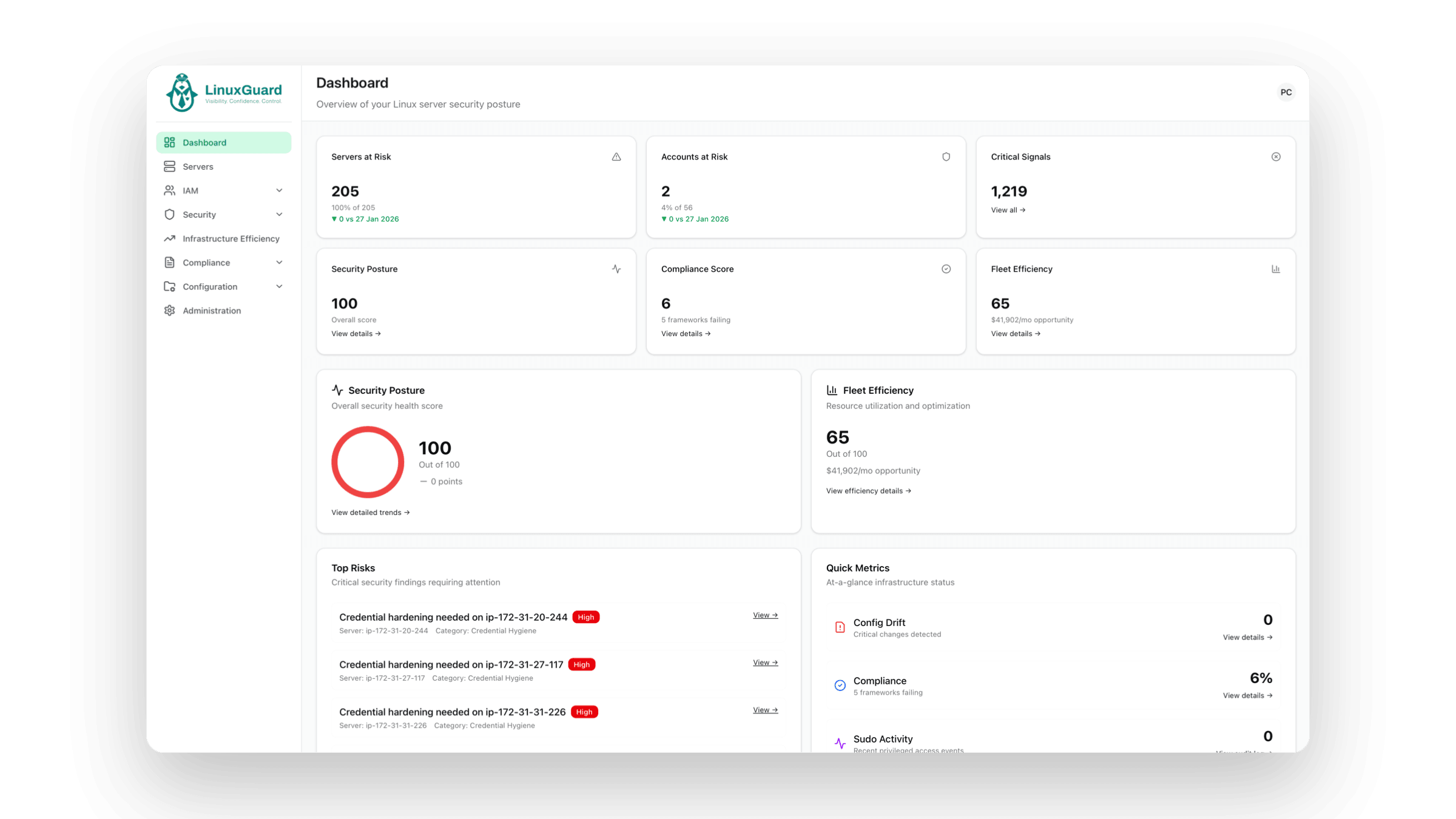
Orphaned accounts, untracked sudo rules, SSH key sprawl — the identity layer on Linux is invisible to your existing security stack. Identity-first security for Linux starts here: LinuxGuard maps every privilege path so you can eliminate blind spots before attackers exploit them. Our 28-day Linux Identity & Security Audit produces a complete privilege map, risk-ranked findings, and board-ready compliance evidence for NIS2, DORA, SOC 2, and CIS — so you walk away with answers, not just data.
- Know every privilege path — See exactly who can sudo to root, which SSH keys grant access, and where service accounts have accumulated excessive permissions
- Prove compliance continuously — Generate auditor-ready evidence for NIS2, DORA, SOC 2, CIS, and ISO 27001 from your actual Linux configuration, not spreadsheets
- Reclaim wasted infrastructure — Identify over-provisioned servers and idle workloads with eBPF-powered utilization intelligence that quantifies savings in dollars
- Reduce risk and spend together — One Linux-native platform that eliminates identity blind spots and right-sizes infrastructure simultaneously
20+ years
Enterprise security: Mastercard, EY, UBS
7+ compliance frameworks
NIS2, DORA, SOC 2, CIS, NIST, PCI-DSS, ISO 27001
28-day delivery
Linux identity audit — fixed scope, fixed fee
Comprehensive Linux Intelligence
LinuxGuard delivers identity-first security for Linux — combining zero trust for Linux, compliance automation, and compute efficiency into a unified, Linux-native platform. Built by experts, for Linux teams.
- See exactly who can sudo to root on every server — eliminate privilege blind spots in hours, not months
- Detect unauthorized SSH key additions and orphaned accounts the moment they appear
- Enforce least privilege without disrupting operations — actionable remediation, not just alerts
- Generate auditor-ready evidence for SOC 2, ISO 27001, NIS2, and DORA from actual Linux configuration
- Reduce audit preparation from weeks of manual gathering to a single structured export
- Prove continuous compliance posture to boards and regulators with historical trend data
- Identify 15-35% infrastructure savings by finding over-provisioned servers and idle workloads
- Quantify every optimization opportunity in dollars — prioritize by business impact, not guesswork
- Right-size infrastructure with eBPF-powered utilization intelligence that sees true resource pressure
Why Linux identity is your most dangerous blind spot
Generalist security tools were built for Windows-first environments — they scan ports and patch CVEs, but they cannot see the Linux-native identity artefacts that attackers exploit first: NOPASSWD sudo rules, shared SSH keys, orphaned service accounts, and PAM configuration drift. Privilege accumulates silently between manual reviews, and most organisations have no way to detect it until something goes wrong. According to CrowdStrike's 2025 report, 79% of attacks on Linux use no malware at all — attackers simply log in with valid credentials that should have been revoked. NIS2 and DORA now require demonstrable identity controls and audit trails, and spreadsheet-based reviews no longer satisfy auditors. Closing this gap requires a Linux-native platform that understands how Linux identity actually works — not a generalised scanner retooled for a different operating system.
Representative findings from LinuxGuard audits
247
orphaned accounts discovered in a 120-server estate
LinuxGuard Audit — Q4 2025
83
NOPASSWD sudo rules removed after first privilege map
LinuxGuard Audit — Q4 2025
14
servers with shared SSH keys granting lateral movement paths
LinuxGuard Audit — Q4 2025
Common questions about Linux identity security
What is Linux IAM?
Linux identity and access management (IAM) means continuous visibility and control over every user account, group membership, sudo rule, SSH key, PAM module, and service account running across your Linux server estate. Unlike directory-only IAM tools — which manage identities in Active Directory or LDAP but cannot see Linux-native artefacts — Linux IAM addresses the identity layer that lives on the servers themselves. Privilege creep, orphaned accounts, and NOPASSWD sudo rules accumulate silently between manual reviews. True identity visibility on Linux requires a platform that continuously reads the filesystem, audit logs, and PAM configuration to detect drift in real time, not a scheduled scan or a spreadsheet updated quarterly.
What is PAM for Linux?
PAM carries two meanings in Linux security, and both matter. Pluggable Authentication Modules (PAM) is the Linux authentication framework that controls how users are verified, sessions are opened, and passwords are enforced across every service on the system — SSH, sudo, login, and custom applications. Privileged Access Management (PAM) is the broader discipline of controlling and monitoring the accounts with elevated access. LinuxGuard maps your entire PAM stack — pam.d configurations, module chains, and session controls — and continuously monitors privileged-account access patterns to detect configuration drift and policy violations before they become security incidents. Understanding both senses is essential for a complete least-privilege posture.
How do I audit sudo access?
Auditing sudo access requires enumerating every sudoers file and drop-in include across your Linux fleet, identifying NOPASSWD rules that allow privilege escalation without a password, mapping group memberships that grant sudo to entire teams rather than named individuals, and reviewing the specific command paths permitted. Running 'sudo -l' on a single server gives a snapshot but is unmanageable at scale — and it captures only the current state, not how access has changed over time. A complete sudo audit requires continuous drift detection: alerting when a new NOPASSWD rule appears, when a user is added to the sudoers group, or when a command restriction is loosened. Zero trust for Linux starts with knowing exactly who can escalate privilege, on which hosts, and under what conditions.
What does a Linux security audit include?
The LinuxGuard 28-day Linux security audit delivers a comprehensive identity map of your entire Linux estate: full user and group inventory, privilege drift detection across all sudoers configurations, SSH key inventory (including shared and unused keys), PAM configuration review, service account inventory (including orphaned accounts no longer tied to active workloads), and a compliance evidence pack mapped to your specific framework. The evidence pack includes the access record auditors need to satisfy SOC 2 CC6, NIS2 Article 21, DORA, and CIS controls — structured so your team can present it without additional preparation. The engagement closes with a least-privilege implementation roadmap your engineering team can act on immediately.
How do I prove Linux compliance for SOC 2 / NIS2?
SOC 2 CC6 and NIS2 Article 21 both require demonstrable evidence of who has access to what systems, when access was granted or changed, and how privileged access is reviewed and revoked. Auditors no longer accept policy documents — they require structured access records, change logs, and evidence of periodic review. LinuxGuard produces the full compliance evidence pack mapped directly to these controls: a timestamped identity map showing every account and privilege path, a privilege drift log showing every change detected during the audit window, and a remediation record showing what was revoked. The pack is formatted for direct submission to your auditors, eliminating the weeks of manual evidence collection that typically precede a SOC 2 or NIS2 assessment.
What is privilege creep on Linux?
Privilege creep is the silent accumulation of permissions over time. A developer is added to the sudoers group for an emergency deployment — and never removed. A service account is granted write access to a sensitive directory for a migration — and the access persists long after the migration completes. An employee leaves, but their SSH keys remain in authorised_keys files on production servers. Each individual change seems minor, but across hundreds of servers and dozens of team changes, the cumulative effect is a Linux estate where far more accounts have far more access than any policy requires. LinuxGuard's continuous drift detection identifies every orphaned account, stale SSH key, and expanding group membership before they become an exploitable attack path or a compliance finding.
How is identity-first security different from traditional Linux server security?
Traditional Linux server security focuses on the software layer: scanning for CVEs, patching vulnerable packages, monitoring open ports, and detecting malware. These controls are necessary but insufficient — they do not address the identity layer. According to CrowdStrike's 2025 Global Threat Report, 79% of attacks on Linux involve no malware at all. Attackers log in using valid credentials — compromised SSH keys, over-privileged service accounts, or sudo rules that should have been removed months earlier. Identity-first security for Linux treats the identity layer as the primary attack surface: who can authenticate, what they can do after authentication, and whether those privileges are still appropriate. Guardrails, not gatekeepers — continuous visibility without disrupting the teams who depend on Linux infrastructure to move fast.
Your Security Tools Were Never Built for Linux Identity
Your SIEM sees logs. Your EDR watches processes. Your CSPM scans cloud configs. None of them map the identity layer where attackers actually operate on Linux -- the sudo rules, PAM configs, SSH keys, and service accounts that define who can do what.
- SIEMs capture authentication events but miss privilege relationships -- they see who logged in, not what they can do
- EDR tools monitor runtime behavior but are blind to identity configuration -- orphaned accounts and excessive sudo rules persist undetected
- CSPM tools scan cloud IAM but skip OS-level identity -- local users, groups, and SSH keys exist outside their scope
- LinuxGuard maps every identity, privilege path, and access relationship across your entire Linux estate





Peter Cummings
Founder & Linux Identity Expert
20+ years building identity and access management at Mastercard, EY, Lonza, and UBS. Peter designed LinuxGuard to solve the identity blind spots he saw firsthand across enterprise Linux estates.
What LinuxGuard Discovers in Your First Audit
Every Linux estate we audit reveals the same critical identity risks. These are the four categories that create the most exposure.
Orphaned accounts
Local users with no owner, no login history, and no last authentication -- still active, still capable of escalating.
Excessive sudo privileges
Broad NOPASSWD rules and ALL permissions granted temporarily, never revoked -- bypassing the last authentication checkpoint.
SSH key sprawl
authorized_keys files with unknown public keys, no rotation policy, and shared keys across users and systems.
Privilege creep
Group memberships accumulated over years of role changes, never reviewed, carrying far more access than the role requires.
Implementation & Advisory Support
LinuxGuard is backed by an expert-led Linux Identity & Security Audit service — identity-first security delivered as a fixed-scope, 28-day engagement. We map every identity and privilege path across your Linux estate, identify the privilege creep that creates real risk, and deliver compliance-ready evidence for boards and auditors. Led by Peter Cummings, with 20+ years of IAM experience at Mastercard, EY, Lonza, and UBS. The audit closes with a least-privilege implementation roadmap and remediation guidance your engineering team can act on immediately — without a lengthy professional services engagement.
Explore ServicesCertified for Your Infrastructure
LinuxGuard is independently certified and validated for the major enterprise Linux distributions — so you know it works in your environment before you deploy.
LinuxGuard is certified SUSE Ready, validated for compatibility with SUSE Linux Enterprise.
 View Certification
LinuxGuard is certified as a Red Hat Certified Technology, validated for compatibility with Red Hat Enterprise Linux, CentOS Stream, and Fedora.
 View Certification
LinuxGuard is validated for Ubuntu LTS and Debian environments, ensuring compatibility with Canonical's long-term support releases.
 View Certification
The Numbers Behind Identity Risk
79%
of Linux attacks use no malware — attackers log in with stolen credentials
CrowdStrike 2025
246 days
mean time to identify and contain credential-based breaches
IBM Cost of Data Breach 2025
$4.67M
average cost of a breach initiated with stolen credentials
IBM Cost of Data Breach 2025
Ready to Secure and Optimize Your Linux Estate?
LinuxGuard is the identity-first security platform for modern Linux infrastructure — zero trust for Linux, compliance automation, and cost optimization in one expert-built solution.